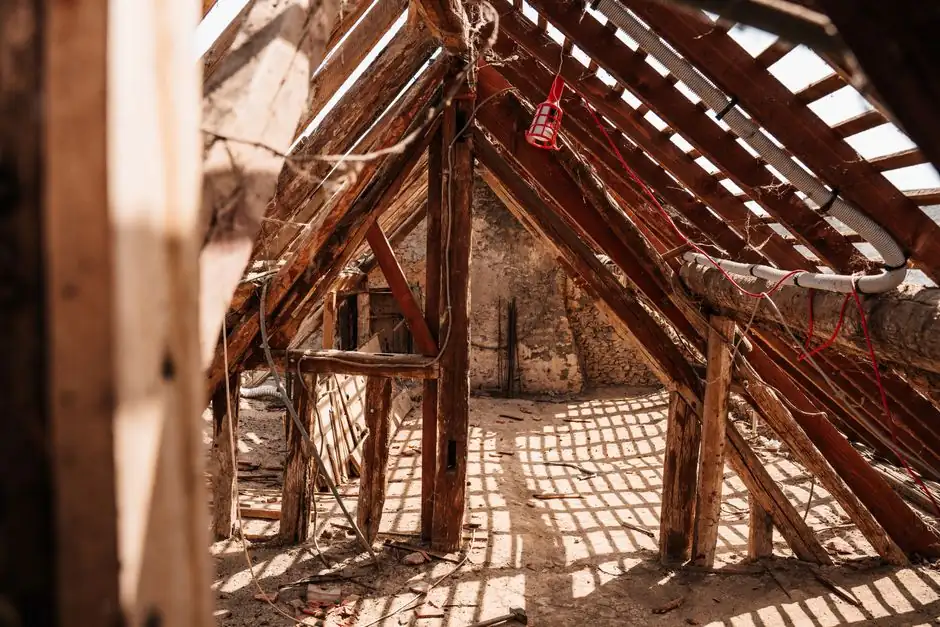
To remove mold after a roof leak water damage repair, you kill the colony, remove every porous material it has grown into, and dry the structure below 15% moisture content so it cannot return. That means containment, HEPA vacuuming, an antimicrobial treatment, and cutting out wet drywall, insulation, or ceiling tile rather than painting over it. The rest of this post walks through the sequence we run in San Marcos attics, what it costs in 2026, and how to keep your insurance claim intact.
Mold is a fungal growth that feeds on wet organic material and releases spores into the air within 24 to 48 hours of a leak. In a Central Texas attic, that clock starts the first time rain pushes past a lifted shingle or a cracked pipe boot.
Why does mold grow after a roof leak?
Mold grows after a roof leak because the leak keeps one small area of wood, drywall, or insulation damp for weeks while the rest of the house looks dry. Roof leaks rarely flood a room. They drip onto a rafter, soak a 2-foot square of decking, and stop. That slow, hidden moisture is the perfect environment for spores that are already in every attic.
Three conditions have to line up, and a roof leak supplies all three:
- Moisture - a steady drip or a slow capillary wick through sheathing keeps wood above 20% moisture content.
- Food - OSB decking, paper-faced drywall, blown-in cellulose, and dust all feed mold.
- Warmth - attics in Hays County hit 130°F to 150°F in July and August, which accelerates growth instead of slowing it.
We see this most in homes built between 1975 and 2005 around Sunset Acres and the older streets off Ranch Road 12, where 3-tab shingles are past their service life and pipe boots have cracked. A leak that starts in May can be a full attic colony by the time the first cool front arrives in October.
If you are still chasing the source, start with roof leak water damage repair San Marcos TX. Killing mold under an active leak is wasted money - the colony comes back in three weeks.
How do you remove mold after a roof leak?
You remove mold after a roof leak by sealing the work area, physically removing contaminated material, treating the remaining structure, and drying it to a verified moisture level. Here is the sequence our crews follow, in order.
1. Stop the water and document everything
No remediation starts until the roof is tarped or repaired. We photograph the leak point, the stained decking, and the moisture readings before anything moves - that file is what your adjuster pays from. If the roof is still open, emergency tarping goes up the same day.
2. Build containment
We hang 6-mil poly sheeting to separate the attic or ceiling work zone from the living space, and run a HEPA air scrubber to keep spore counts down. A single attic disturbance can push thousands of spores per cubic meter into a bedroom. Containment is not optional.
3. Remove porous material
Anything mold has grown into comes out. That usually means:
- Wet blown-in insulation in a 4- to 8-foot radius around the leak
- Stained or soft drywall and ceiling board
- Paper-facing on drywall that stayed wet more than 48 hours
- Cardboard, fabric, and stored boxes in the attic
We bag it in the attic and carry it out sealed. Walking contaminated debris through a hallway spreads the problem to rooms that were clean.
4. HEPA vacuum and treat the structure
Framing, decking, and joists get HEPA-vacuumed, then treated with an EPA-registered antimicrobial. Surface mold on solid lumber wipes off. Mold that has stained the wood grain 1/8 inch deep means the lumber is compromised and gets replaced.
5. Dry the structure and verify
We set air movers and an LGR dehumidifier and log moisture readings daily until framing reads below 15% and drywall below 1%. That usually takes 3 to 5 days in an attic, longer if the roof leak ran for months. You get the readings in writing.
For the drying side of the job, our structural drying San Marcos TX crews work the same containment we build for remediation, so you are not paying two companies to set up twice.
6. Replace what came out
New insulation, new drywall, primer, and paint go back after the final moisture check passes. If the attic had a musty smell that lingered, we finish with a hydroxyl or ozone treatment to neutralize odor compounds in the framing.
Can a roof leak cause black mold?
Yes - a roof leak can cause black mold, and in San Marcos attics it usually does. The most common species we find on wet roof decking is Stachybotrys chartarum, the greenish-black mold people mean when they say black mold. It needs cellulose and constant moisture, which is exactly what a slow roof leak delivers.
Not every dark stain is black mold. Roof decking that got wet once and dried often shows dark water staining with no active growth. The difference is texture and moisture: active black mold is slimy when wet and powdery when dry, and the wood under it reads above 20% on a pin meter.
If you are not sure what you are looking at, mold inspection and testing San Marcos TX gives you a lab result in 2 to 3 days instead of a guess. We take air samples inside the attic and in the living space below so you know whether spores have migrated.
When the lab confirms Stachybotrys or another toxigenic species, the job moves to black mold removal San Marcos TX protocols: full containment, negative air pressure, PPE, and disposal as contaminated waste. That is not a shop-vac and bleach weekend.
What it costs in San Marcos in 2026
Typical 2026 pricing for roof leak mold removal in San Marcos runs $1,200 to $3,500 for an attic or ceiling job under 100 square feet, and $4,000 to $9,000 when the leak ran for months and spread into insulation, drywall, and framing across a larger area. The variables that move the number are square footage, how deep the mold grew into the material, and whether contents need cleaning.
Here is how the line items usually break down:
- Mold inspection and lab testing: $250 to $600
- Containment and HEPA filtration: $400 to $900
- Removal of contaminated insulation and drywall: $3 to $7 per square foot
- Antimicrobial treatment of framing: $1 to $2 per square foot
- Structural drying (3 to 5 days): $900 to $2,200
- Insulation replacement: $1.50 to $3.50 per square foot installed
Roof repair itself is separate and typically runs $450 to $1,800 depending on whether we are replacing a pipe boot, a section of decking, or a full slope of shingles. We quote the whole job upfront so you are not approving change orders mid-project.
Does insurance cover roof leak mold removal?
Homeowners insurance usually covers mold removal after a roof leak when the leak itself was sudden and accidental - a storm that tore off shingles, a fallen limb, a hail strike. It usually does not cover mold from a leak you knew about and let run for a year, because insurers treat that as neglected maintenance.
Two numbers matter on a Texas HO-B or HO-3 policy. Most policies cap mold remediation at $10,000 unless you bought a higher endorsement. And most require you to report the loss and mitigate further damage promptly - meaning tarping and drying, not waiting for the adjuster to visit.
What we do to protect the claim:
- Photograph the leak point, the damaged decking, and every moisture reading with timestamps
- Write a scope that separates roof repair, water damage, and mold remediation line items
- Meet your adjuster on site and walk the attic with them
- Provide the lab report if testing was done
If you want help with that paperwork, our insurance claim assistance San Marcos TX team handles the documentation and the adjuster meeting so you are not translating between a roofer, a remediator, and a claims desk.
Common mistakes we see on roof leak mold jobs
Most failed mold jobs in San Marcos fail for the same five reasons. Any one of them turns a $2,000 remediation into a repeat visit next spring.
- Bleaching the surface. Bleach kills mold on non-porous tile and glass. On OSB decking and drywall paper it kills the top layer and leaves the roots, which regrow in 3 to 4 weeks.
- Painting over the stain. Kilz and mold-resistant paint hide the evidence and trap moisture in the substrate. The mold eats through the paint from behind.
- Skipping containment. No poly, no HEPA, no negative air. Spores land in the bedroom below and you have a second problem.
- Fixing the mold before the roof. If the leak is still active, everything you remove grows back.
- Not drying the framing. Remediation without verified drying leaves wood at 25% moisture. Mold returns the first humid week.
One more: leaving wet insulation in place because it "looks fine." Blown-in cellulose holds water like a sponge and will not dry in an attic on its own.
When to call a professional
Call a professional when the mold covers more than 10 square feet, when the leak has been active for more than two weeks, when you smell a musty odor in rooms below the attic, or when anyone in the house has asthma or a compromised immune system. Those are the thresholds where DIY turns into a health issue and a failed insurance claim.
San Marcos Water Restoration Pros handles the whole sequence - tarping, roof leak repair, mold remediation, drying, and rebuild - with one crew and one scope. We work in Kyle, Buda, Wimberley, and New Braunfels as well, and we can usually be on site the same day you call.
If the leak also pushed water into a lower level, we handle that with water damage restoration services San Marcos TX under the same claim.
Frequently Asked Questions
How do you remove mold after a roof leak?
Seal the area with poly and HEPA filtration, remove all moldy porous material (insulation, drywall, ceiling board), HEPA-vacuum and apply an EPA-registered antimicrobial to the framing, then dry the structure below 15% moisture content. Most attic jobs take 3 to 5 days of drying plus 1 to 2 days of removal and rebuild.
Can a roof leak cause black mold?
Yes. A slow roof leak keeps roof decking and insulation damp for weeks, which is exactly what Stachybotrys chartarum needs. We find it in San Marcos attics most often on OSB decking under failed pipe boots and 3-tab shingles. Lab testing confirms the species in 2 to 3 days.
How much does mold remediation cost after a roof leak in San Marcos TX?
In 2026, most San Marcos attic and ceiling jobs run $1,200 to $3,500 for areas under 100 square feet, and $4,000 to $9,000 when mold spread into insulation, drywall, and framing. Testing adds $250 to $600. Roof repair is quoted separately.
Does insurance cover roof leak mold removal?
Usually yes when the leak was sudden and accidental - storm damage, hail, a fallen limb. Most Texas policies cap mold remediation at $10,000 and exclude mold from long-term neglect. Report the loss and start mitigation quickly to protect the claim.
How long does mold removal take?
An attic job under 100 square feet typically takes 4 to 7 days total: 1 to 2 days for containment and removal, 3 to 5 days of drying with daily moisture logs, then 1 day for insulation and drywall replacement. Larger jobs with contents cleaning run 10 to 14 days.
Get help with water damage restoration in San Marcos
If a roof leak left mold in your attic or ceiling, we will inspect it, test it, and give you a written scope the same week. Call San Marcos Water Restoration Pros at 512-325-0105 and we will get the leak stopped, the mold out, and the structure dry.